On this page
If you have heard "AI harness" and thought, "is this just prompt engineering in a nicer jacket?", fair.
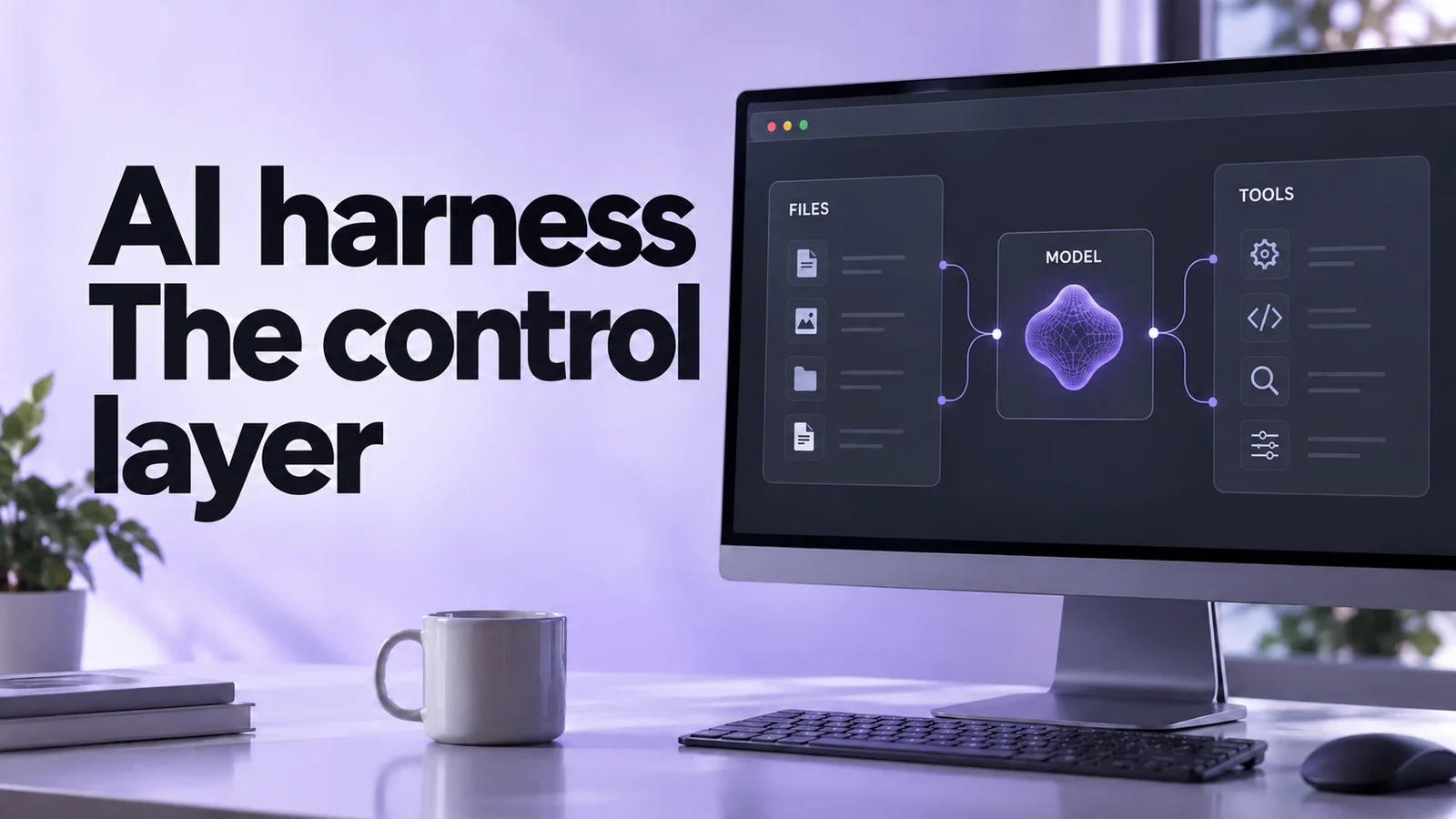
The name sounds like something a vendor would invent after lunch. But the idea is actually useful.
An AI model is not an AI worker. A model can reason, write, classify, summarize, code, and plan. But it does not automatically know your policies, remember where a job stands, call the right tool safely, check whether the result worked, or ask a human before it does something expensive.
The harness is the layer around the model that makes those things happen.
Short version: the model is the engine. The harness is the rest of the car: steering, brakes, dashboard, seatbelts, GPS, maintenance lights, and the rule that says the car should not drive into a wall just because the engine is powerful.
Visual map: the model sits inside the harness. Each outer box is a control layer that makes AI usable for real work.
What the internet means by "AI harness"
The term appears in a few slightly different ways online, which is why it feels messy at first.
Some people say agent harness and mean the runtime around an AI agent: tools, memory, sandbox, file system, browser, workflow loop, permissions, and logging. LangChain summarizes it with the useful line: Agent = Model + Harness.
Some people say harness engineering and mean the discipline of designing that layer. OpenAI used the term in February 2026 while describing how a small team used Codex agents to build a large internal product, with humans steering and agents executing. Birgitta Böckeler’s article on Martin Fowler’s site frames harness engineering as the use of guides and sensors: things that steer the agent before it acts, and things that detect whether the work was good after it acts.
And sometimes people use evaluation harness to mean a testing environment for AI agents, like a benchmark that gives tasks, runs the agent, and scores the result.
Those are related, but for business and automation work I would use this definition:
An AI harness is the operating layer around a model that controls what it can see, what it can do, how it remembers, when it must stop, and how its work gets checked.
That is the difference between a chatbot and a system.
Why models alone are not enough
The AI market loves model names because they are easy to compare. This model is faster. That one is cheaper. This one has a bigger context window. That one writes better code.
Useful, yes. Complete, no.
A raw model is like hiring a very smart person and dropping them into your company with no laptop, no access rules, no onboarding, no manager, no checklist, no CRM login, no approval process, and no way to know whether the work they did was correct.
Then we act surprised when it makes things up.
The problem is not always intelligence. Often, the problem is environment.
If the AI cannot see the right policy, it guesses. If it can access every tool with no permissions, it becomes risky. If it cannot verify results, it declares victory too early. If it has no memory or state, long work falls apart. If nobody logs decisions, you cannot audit what happened later.
That is harness territory.
Prompt, context, agent, harness: the clean difference
Here is the simplest split:
| Term | What it controls | Simple example |
|---|---|---|
| Prompt engineering | How you ask | "Respond in plain English and ask one question if unsure." |
| Context engineering | What the model sees | Pulling the right policy, customer record, or document into the task. |
| Agent | The model plus a goal and tool use | "Check this invoice, compare it to the PO, and draft the reply." |
| Harness | The operating system around the agent | Permissions, tools, memory, approvals, tests, logs, retries, and escalation. |
A prompt can improve one answer. Context can improve one decision. A harness improves the repeatable workflow.
That is why this matters.
A real-world example: the refund agent
Imagine a customer asks for a refund.
Without a harness, you might send the message to a model and hope it writes a helpful response.
With a harness, the workflow looks different:
Customer request
-> Detect intent and risk
-> Retrieve order history and refund policy
-> Remove or protect sensitive data
-> Ask the model for a recommendation
-> Check policy, amount, and customer status
-> If low risk, draft the response
-> If high risk, request human approval
-> Log the decision and outcome
Notice what happened. The model did not become magically smarter. The system around it became more responsible.
The harness decides what data is relevant, what tools are allowed, what counts as risky, what needs approval, and what evidence should be stored.
That is the real work.
The pieces of a good AI harness
You do not need to memorize a new framework. Think of a harness as seven layers.
Instructions: The rules before action. Role, tone, policies, success criteria, and hard limits.
Context: The right information at the right time. Not every document. Not the entire internet. Just the pieces needed for the task.
Tools: The approved ways to act. APIs, databases, n8n workflows, browser actions, file systems, emails, tickets, or internal apps.
Memory and state: What the system needs to remember. Preferences, previous decisions, task progress, open loops, and handoffs.
Guardrails: The things that stop bad actions before they happen. Input checks, output checks, spending limits, policy gates, PII handling, and human approval.
Feedback sensors: The proof after action. Tests, logs, screenshots, evaluations, monitoring, and review.
Orchestration: The traffic control. Which specialist handles which part, when to call another tool, when to retry, and when to escalate.
This is why "AI harness" is a better concept than "better prompt". The prompt is one component. The harness is the operating environment.
The n8n version of this idea
If you build automations, the harness idea should feel familiar.
In n8n terms, a lightweight harness could look like this:
Trigger
-> Normalize input
-> Fetch context
-> Guardrail check
-> AI decision
-> Human approval if needed
-> Approved tool action
-> Log outcome
-> Monitor failure patterns
The trick is to stop treating the AI node as the whole product. The AI step is one decision point inside a bigger system. The harness is the workflow that makes that decision useful, safe, and repeatable.
When do you actually need a harness?
You do not need a full harness for every AI task.
If you are brainstorming a title, summarizing a document for yourself, or asking a one-off question, a normal chat is fine. Do not build a spaceship to make a sandwich.
You need a harness when the task has one or more of these properties:
- It repeats often.
- It touches customer, employee, financial, legal, or private data.
- It takes action outside the chat window.
- A wrong answer costs money, trust, compliance risk, or operational pain.
- More than one person or team depends on the output.
- You need logs, approvals, or a way to explain what happened.
- The task takes multiple steps and can fail halfway through.
In other words: if the AI is moving from "assistant" to "operator", it needs a harness.
The common mistakes
The first mistake is buying a model and calling it a strategy. Better models help, but they do not replace process design.
The second mistake is giving the AI too many tools too early. Tool access is power. Power needs permissions, logs, and a recovery path.
The third mistake is trusting the AI to verify itself with no external signal. "Looks good" is not a test. Use checks that exist outside the model whenever possible.
The fourth mistake is hiding key knowledge in Slack threads, meetings, or people's heads. If the system cannot retrieve it, the AI cannot use it.
The fifth mistake is treating guardrails as a final polish step. Guardrails are not decoration. They are part of the architecture.
The easiest way to explain it to non-technical people
Try this:
A model is a smart employee. A harness is the workplace that makes the employee productive and safe.
The workplace includes onboarding, files, tools, permission levels, managers, checklists, QA, security rules, escalation paths, and records of what happened.
You would never hire a smart person and say, "Here is full access to finance, legal, support, and production. Good luck."
But that is exactly how many AI demos are built.
My take
"AI harness" is not a magic term. It is a useful reminder that the value of AI does not live only inside the model.
The model gives you intelligence. The harness gives that intelligence a job, a workspace, limits, memory, tools, and accountability.
That is where the boring work happens. And, annoyingly, the boring work is usually the part that makes the demo survive contact with the real world.
If you remember one thing, make it this:
The model answers. The harness makes the answer operational.
That is the jump from AI that looks impressive to AI that actually helps a business.

Discussion
Comments
No published comments